
You woke up this morning and realized you couldn't turn your head to the right. Or maybe the stiffness came on gradually over the past few days, getting progressively worse until simple movements like checking your blind spot while driving have become genuinely painful. Whatever brought you here, you need relief, and you need it now.
Here's the thing most stiff neck advice gets wrong: it treats every case the same way. Take some ibuprofen, apply heat, do a few stretches, and hope for the best. But stiff neck isn't one condition with one solution. Understanding which type you have determines not just what works today, but whether this will be the last time you deal with this problem or just another temporary fix in an endless cycle.
This guide gives you both immediate relief for the acute pain you're experiencing right now, and the framework to identify whether you're dealing with a one-time issue that will resolve on its own, or a recurring pattern that requires a different approach entirely.
🚨 When to See a Doctor Immediately
Before we go any further, let's address the situations where you should stop reading and seek medical attention right away.
SEEK EMERGENCY CARE IF YOU HAVE:
- ❌ Severe headache with stiff neck (possible meningitis)
- ❌ Fever + neck stiffness
- ❌ Numbness or tingling in arms/hands
- ❌ Weakness in arms or hands
- ❌ Loss of balance or coordination
- ❌ Difficulty swallowing or breathing
- ❌ Recent trauma (car accident, fall, impact)
- ❌ Progressive worsening despite rest
✅ If none of these apply, continue reading. What you're experiencing is almost certainly a mechanical issue that will respond to the appropriate treatment approach.
Understanding the Two Types of Stiff Neck
Stiff neck falls into two distinct categories, and recognizing which one you have changes everything about how you should approach treatment and what to expect going forward.
Type 1: Acute Stiffness (Sudden Onset)
You went to bed feeling fine and woke up unable to move your head properly. Or you turned your head quickly to respond to someone calling your name and felt an immediate sharp restriction in your range of motion. This type typically has a clear triggering event: sleeping in an awkward position, sudden exposure to cold air, or a quick movement that caught your muscles off guard. These acute episodes are genuinely new events, not flare-ups of an ongoing problem. Before this happened, your neck functioned normally without any sense of chronic tightness or restriction.
Type 2: Chronic Stiffness (Recurring Pattern)
If you experience episodes of neck stiffness three or more times per year, you're dealing with something different than simple muscle strain. You might notice that your neck always feels somewhat tight even when you're not in an acute episode, or that your range of motion has gradually decreased compared to a few years ago. Small triggers that wouldn't bother most people cause significant flare-ups for you. The relief methods work to reduce your acute pain, but the underlying tightness never fully resolves, and within weeks or months, another trigger sets off the cycle again.
The distinction matters because while both types benefit from the same immediate relief techniques, they require completely different long-term approaches. Acute stiffness resolves on its own with appropriate care. Chronic stiffness is a symptom of underlying postural dysfunction that will continue causing problems until you address the root cause.
Which Pattern Do You Have?
CHECK ALL THAT APPLY:
ACUTE PATTERN
- ☐ First time with significant stiff neck
- ☐ Clear trigger event (slept wrong, sudden movement)
- ☐ Neck functioned normally before this
- ☐ No history of recurring neck issues
- ☐ Stiffness in one specific spot
→ If you checked 4-5 boxes above:
You have acute stiffness. Follow the immediate relief methods below. You should see steady improvement over 3-7 days.
CHRONIC PATTERN
- ☐ Stiff neck happens 3+ times per year
- ☐ Often wake up with neck stiffness
- ☐ Neck always feels somewhat tight
- ☐ Range of motion decreased over years
- ☐ Minor triggers cause major flare-ups
- ☐ Relief is always temporary
→ If you checked 4-6 boxes above:
You have chronic recurring stiffness. The immediate relief methods will help this episode, but you need to address the underlying postural dysfunction. Scroll down to "Understanding Your Postural Dysfunction" after trying the relief methods.
If You Have Acute Pattern: Your Action Plan
First 24 Hours
Focus on ice application—fifteen minutes on, forty-five minutes off, repeated four to six times throughout the day. Combine this with gentle range of motion exercises for five minutes three times during the day, and self-massage work before bed to prevent the muscles from fully seizing overnight.
Days 2-3
Switch from ice to heat application. The inflammatory phase has passed, and now heat will be more effective at increasing blood flow, relaxing the tight muscles, and reducing your stiffness. Continue with range of motion exercises and increase the frequency of self-massage work to help the muscles release their protective tension. Most people notice significant improvement during these days as the acute inflammation resolves and mobility starts returning.
Days 4-7
You should be experiencing eighty to ninety percent improvement. If you're not seeing this progression, or if your symptoms are getting worse instead of better, schedule an appointment with your healthcare provider to rule out complications like nerve impingement or structural issues that basic care measures can't address.
Ice and Heat: Understanding the Protocols
Ice Application (First 48 Hours)
When: Acute onset, sharp pain, inflammation
Why: Ice during the first forty-eight hours serves a specific purpose: reducing the inflammatory response. Acute stiffness involves your body sending extra blood flow and inflammatory mediators to the area it perceives as injured. While inflammation is part of healing, excessive inflammation causes unnecessary pain and restriction. Ice reduces this by causing vasoconstriction, decreasing metabolic activity, and directly numbing pain signals.
How to Apply:
- Wrap ice in towel (or use frozen peas)
- Apply 15 minutes
- Remove 45 minutes
- Repeat 4-6x first day
- Continue for 48 hours
Heat Application (After 48 Hours)
When: After 48 hours, chronic stiffness
Why: After forty-eight hours, switch to heat. Once the inflammatory phase passes, heat becomes more beneficial. It increases blood flow to bring oxygen and nutrients needed for healing while carrying away metabolic waste. It also has a direct relaxing effect on muscle tissue, reducing the protective spasm contributing to your stiffness.
How to Apply:
- Use heating pad/shower/warm towel
- Apply 15-20 minutes
- Repeat every 2-3 hours
- Best before bed
Best Method: Stand in a hot shower and let the water hit your neck for five to ten minutes while simultaneously performing slow, gentle range of motion exercises. The combination of heat, gentle movement, and the massaging effect of the water often provides more relief than any single intervention alone.
Self-Massage for Trigger Point Release
Muscle tension in stiff neck often concentrates in specific trigger points rather than being evenly distributed. These feel like knots or tender spots, and when pressed, often cause pain that radiates to other areas.
Upper Trapezius Release
- Reach your right hand over to your left shoulder
- Locate the thick band of muscle between your neck and shoulder top
- Using your thumb and fingers, pinch this muscle and apply moderate pressure
- Look for spots that feel tender (around 6/10 intensity)
- When you find a trigger point, hold steady pressure for 30 seconds
- Work through 3-4 spots on each side
Suboccipital Release (Tennis Ball Method)
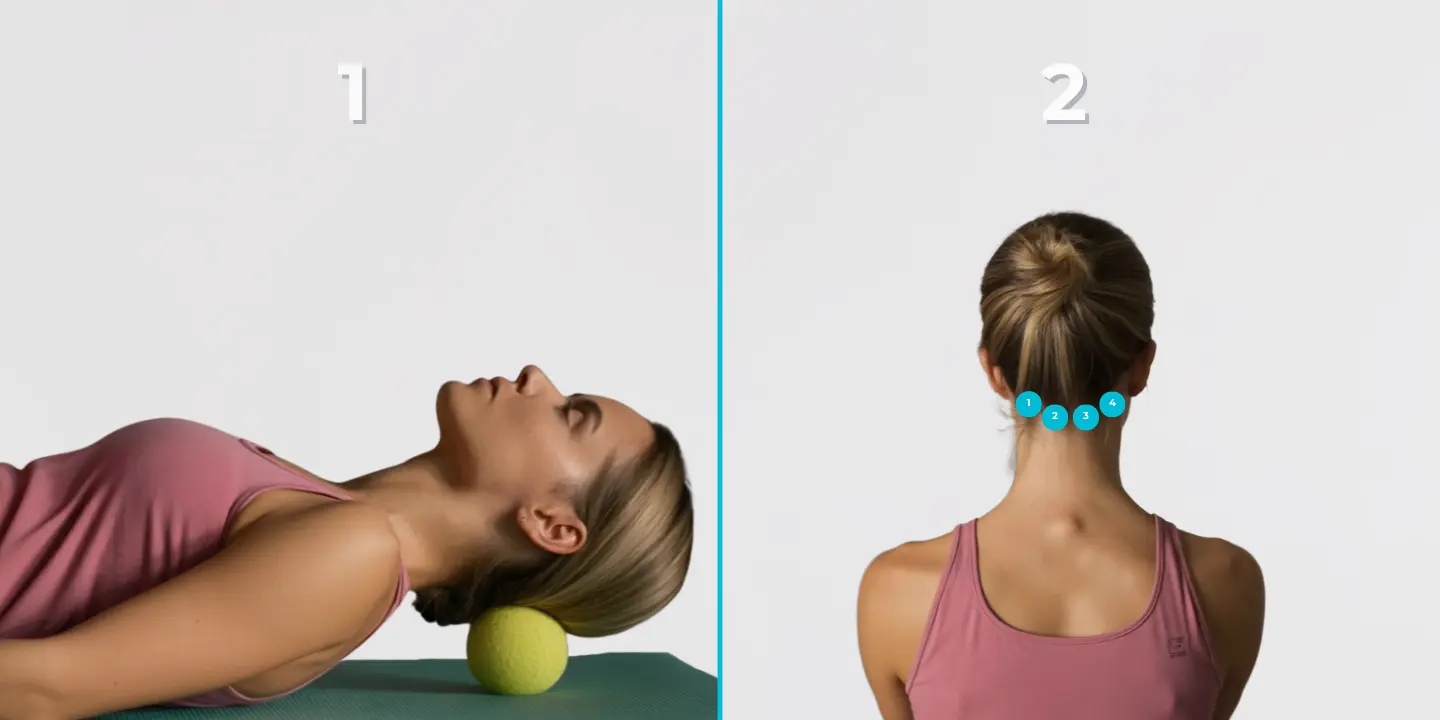
Suboccipital release using tennis balls helps release deep tension at the base of the skull
- Lie on your back
- Position two tennis balls in a sock side by side
- Place them at the base of your skull where it meets your neck
- Let your head's weight rest on the balls (don't press actively)
- Make small nodding motions
- Maintain position for 60-90 seconds
- Note: If you feel dizzy, reduce pressure or stop
Gentle Movement to Maintain Mobility
While rest might seem best for a stiff neck, complete immobility often makes the problem worse. Gentle movement within your pain-free range maintains what mobility you have and promotes healing blood flow.
Slow Head Turns
- Turn your head slowly to the right, going only as far as feels comfortable
- Hold for 3 seconds, then return to center
- Repeat to the left
- Complete 5 repetitions in each direction
Key principle: Move within your pain-free range—you're maintaining mobility, not trying to force improvement.
Ear to Shoulder Tilts
- Sit or stand upright with your shoulders relaxed
- Slowly tilt your right ear toward your right shoulder, keeping your face forward (don't rotate)
- Go only as far as feels comfortable without forcing the stretch
- Hold for 3 seconds, then return to center
- Repeat to the left side
- Complete 5 repetitions in each direction
Key principle: You should feel a gentle stretch on the opposite side of your neck—if you feel pain, reduce your range.
Shoulder Rolls
Roll your shoulders backward in large circles 10 times. This movement helps release the upper trapezius muscles that contribute to neck stiffness through connected muscle chains.
Frequency:
- • Days 1-2: Every 2-3 hours
- • Days 3-4: 3-4 times daily
- • Day 5+: Morning and evening sessions
Most people regain 50-70% of normal range of motion within 48 hours when combining gentle movement with ice, heat, and self-massage.
If You Have Chronic Pattern: Understanding Your Postural Dysfunction
The immediate relief methods above will help your current episode—most people experience fifty to seventy percent improvement within forty-eight hours. But if you have chronic recurring stiffness, these methods only address the symptom (the muscle spasm) without touching the cause (postural dysfunction).
Here's what's really happening:
When your head sits forward of your shoulders, even by just an inch or two, the muscles in the back of your neck work overtime to prevent your head from falling forward. Over months and years, these muscles adapt by becoming chronically tight and shortened. This becomes your new normal—a baseline level of tension that never fully releases.
Then when a small trigger occurs (sleeping slightly wrong, looking down at your phone, turning your head quickly), these already-tense muscles can't accommodate the additional demand. They seize up into the acute stiffness you're experiencing right now. You get relief, feel better, return to normal activities... and within weeks or months, another trigger sets off the cycle again.
Unless you correct the underlying postural dysfunction, your stiff neck will keep coming back. The triggers might change, but the pattern remains the same.
The good news: Once you identify which specific type of postural dysfunction you have, you can address it systematically and break the cycle permanently.
Three Types of Postural Dysfunction That Cause Chronic Stiff Neck
Most chronic stiff neck falls into one of these three categories. Identifying yours determines your path forward.
Type 1: Text Neck (Device-Related Dysfunction)
You likely have Text Neck if:
- ✓ Use smartphone 3+ hours daily
- ✓ Stiffness worse after phone or computer use
- ✓ Looking down at devices triggers episodes
- ✓ Forward-rounded posture visible in photos
- ✓ Desk job or heavy device user
- ✓ Pain/stiffness concentrated in lower neck (C5-C7)
What's happening: Constantly looking down at devices creates chronic flexion of your cervical spine. The muscles in the back of your neck work continuously to support your head's weight at this unnatural angle. Over time, this creates structural adaptation that makes you vulnerable to recurring episodes.
Comprehensive desk ergonomics, smartphone positioning protocols, and device-specific corrective exercises
Type 2: Forward Head Posture (General Postural Dysfunction)
You likely have FHP if:
- ✓ Head sits visibly forward of shoulders when standing
- ✓ Chronic tension headaches (2+ times per week)
- ✓ Can't touch back of head to wall while standing with back against it
- ✓ Rounded upper back (thoracic kyphosis)
- ✓ Stiffness not specifically related to device use
- ✓ Pain/stiffness across entire posterior neck
What's happening: Your head has migrated forward of its ideal position over your shoulders, creating a mechanical disadvantage for your neck muscles. For every inch your head sits forward, it adds 10 pounds of force your neck muscles must counter. This constant load creates the chronic tension that makes you vulnerable to acute episodes.
Detailed wall test assessment, progressive strengthening protocols, and postural retraining methods
Type 3: Dowager's Hump (Cervical-Thoracic Junction Dysfunction)
You likely have Dowager's Hump if:
- ✓ Visible bump or rounding at base of neck/top of upper back
- ✓ Stiffness combines with visible postural change
- ✓ Pronounced rounding at cervical-thoracic junction
- ✓ Often triggered by prolonged slouching
- ✓ May have increased after significant weight change or aging
- ✓ Difficulty finding comfortable sleep position
What's happening: Excessive rounding in your upper back (thoracic spine) forces your neck to compensate by extending backward to keep your eyes level. This creates a hinge point at the cervical-thoracic junction where chronic tension accumulates, making you vulnerable to recurring episodes.
Sleep position optimization, thoracic extension protocols, and cervical-thoracic junction correction exercises
Not sure which type applies to you? Want to see the complete systematic approach that addresses all three?
Ready to Eliminate Recurring Stiff Neck Permanently?
If you have chronic recurring stiffness—or you're uncertain which specific dysfunction type you have—you need to address the underlying postural dysfunction systematically.
The BaseHealthBlueprint Posture Reset Blueprint includes the complete protocol that addresses all three dysfunction types with an 8-week systematic approach. Whether you have text neck, forward head posture, or dowager's hump, the comprehensive protocol corrects all postural components.
See the Complete Solution Now →