
You lie in bed scrolling sleep advice articles. "Try melatonin." "Keep your room dark." "Avoid screens before bed." You've read it all. Tried most of it. Some nights are slightly better. Most nights, the same frustrating pattern: lying awake watching the clock, or falling asleep only to wake at 2 AM with your mind racing.
What if the solution isn't another supplement or sleep app—but understanding the biological mechanisms that control sleep quality?
Your body has specific physiological requirements for initiating and maintaining deep sleep. When these requirements are met, sleep happens naturally. When they're not, you're fighting against your biology—which explains why willpower and determination don't work.
The Science—How Your Body Initiates and Maintains Sleep
Sleep isn't passive. It's an active physiological process requiring specific biochemical and neurological conditions.
The Three Requirements:
Parasympathetic activation
Your nervous system must shift from sympathetic (alert) to parasympathetic (rest) dominance
Sleep requires parasympathetic nervous system dominance. Your sympathetic system (fight-or-flight) must deactivate for your body to transition into restorative states. This isn't just "relaxation"—it's measurable changes in heart rate variability, respiratory rate, and blood pressure. When sympathetic tone remains elevated due to stress or structural factors, stage 3 deep sleep becomes physiologically impossible.
Thermoregulatory trigger
Core body temperature must drop to initiate sleep
Your core body temperature follows a circadian rhythm, dropping 2-3 degrees Fahrenheit before sleep onset. This temperature decline triggers drowsiness through effects on your sleep-wake centers in the hypothalamus. When your bedroom is too warm (above 70°F), this natural temperature drop can't occur efficiently. Your body prioritizes thermal regulation over sleep initiation.
Neutral cervical alignment
Your neck position must allow brainstem decompression
Your brainstem—located where your skull meets your neck—contains the reticular activating system (RAS), the neural network that determines your arousal state. When your cervical spine is properly aligned during sleep, this region functions optimally, allowing your nervous system to transition into deep restorative states. Misalignment at this junction can create mechanical interference with sleep regulation, regardless of other factors.
Most sleep advice addresses one or two of these factors. But sustainable improvement requires all three functioning correctly.
What This Guide Provides:
Three evidence-based techniques targeting these physiological requirements. These prove the concept works (providing 15-25% improvement). But there's a fourth factor most people don't know about—a structural component involving your daytime positioning that determines whether your nervous system can actually achieve deep sleep, even when everything else is optimized.
We'll address that critical missing piece after you understand these foundational techniques.
Three Evidence-Based Techniques
These three techniques target the physiological mechanisms required for sleep. They're not "sleep tips"—they're evidence-based interventions addressing specific biological requirements.
Breathing for Parasympathetic Activation
What It Targets: Autonomic nervous system state—shifting from sympathetic (alert) to parasympathetic (rest) dominance
Why It Works: Extended exhalation stimulates your vagus nerve, directly activating parasympathetic response. This produces measurable decreases in heart rate and blood pressure—the physiological prerequisites for sleep.

Box breathing (4-4-4-4 pattern) activates vagus nerve for parasympathetic dominance
How to Implement:
Lie in bed ready for sleep. Inhale through nose for 4 counts. Hold breath for 4 counts. Exhale through mouth for 4 counts. Hold empty for 4 counts. Repeat for 5-8 complete cycles (3-5 minutes total). Focus only on counting and breathing rhythm. This creates rhythmic vagal stimulation, lowering heart rate and preparing body for sleep.
What to Expect:
- Heart rate decreases 8-12 beats per minute within 3-5 minutes
- Physical sensation of calm (parasympathetic activation)
- Mental quieting (reduced rumination)
- Sleep onset within 15-20 minutes
- 5-10% improvement in sleep quality
Why This Alone Isn't Enough: Breathing addresses immediate autonomic state but doesn't retrain your nervous system's baseline tone or address the structural positioning that maintains sympathetic activation. The tension returns daily.
Temperature Protocol
What It Targets: Core body temperature regulation—the physiological trigger for sleep onset
Why It Works: Your hypothalamus initiates sleep when core temperature drops. Cool ambient temperature (65-68°F) facilitates this decline. Warm extremities help dissipate heat from your core.
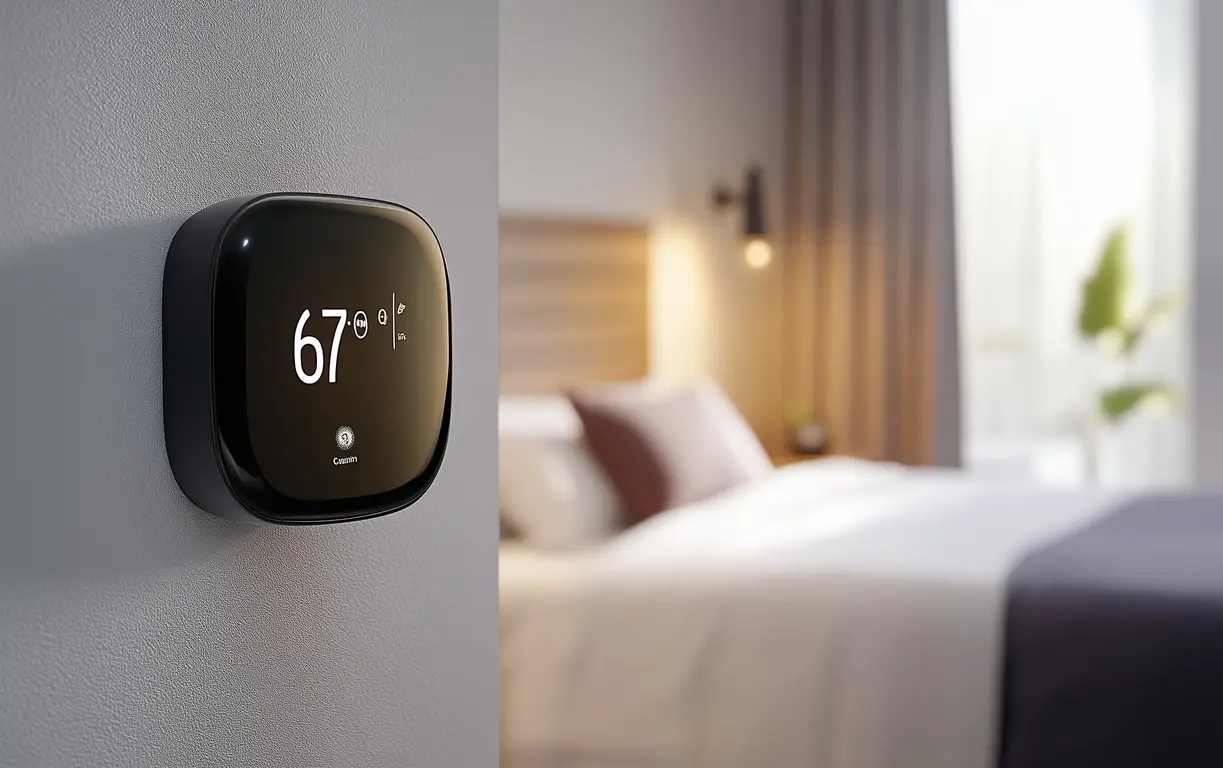
Optimal sleep temperature: 65-68°F for natural core temperature decline
How to Implement:
Set bedroom temperature to 65-68°F one hour before bed. Use breathable bedding (cotton or linen, not synthetic). Keep hands and feet outside covers if comfortable (maximizes heat dissipation). Take warm shower ninety minutes before bed (the subsequent cooling mimics natural temperature drop). Wear socks if cold extremities prevent sleep (increases peripheral blood flow).
What to Expect:
- Sleep onset occurs 15-20 minutes faster
- Fewer night wakings (thermoregulation no longer interrupts sleep cycles)
- Deeper stage 3 sleep (measured via sleep tracking if available)
- 5-10% improvement in sleep quality
Why This Alone Isn't Enough: Optimal temperature addresses thermoregulation but not structural positioning or baseline autonomic tone. Many people in perfectly cool rooms still have neural tension preventing deep sleep.
Pillow Height Optimization
What It Targets: Cervical spine alignment during sleep—maintaining neutral head position relative to your shoulders
Why It Works: Improper pillow height creates cervical flexion (chin tucked) or extension (head tilted back)—both positions create neural tension at the brainstem that prevents deep sleep stages. Neutral alignment allows your nervous system to maintain parasympathetic dominance.
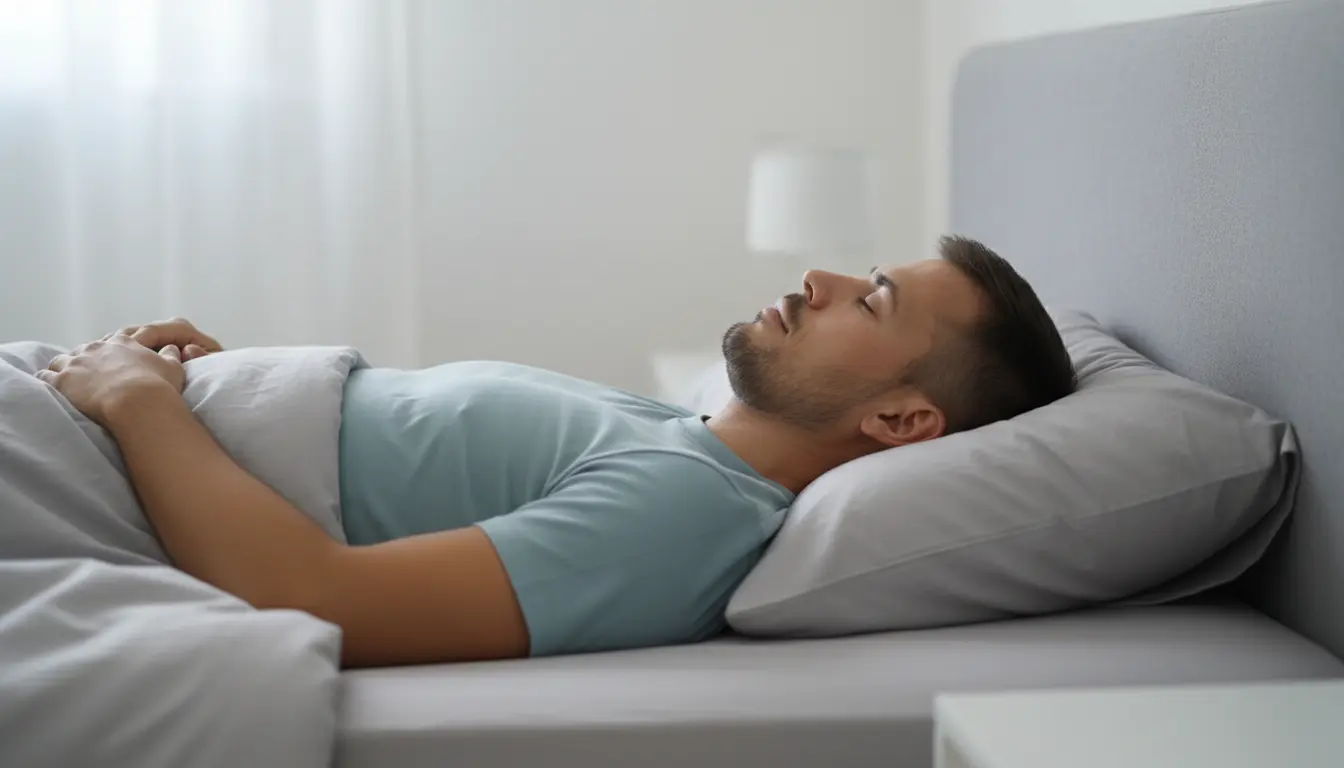
❌ Incorrect: Excessive pillow height tilts head upward, compressing cervical spine

✅ Correct: Thin pillow maintains neutral cervical alignment and natural neck curve
How to Implement:
For side sleepers: Measure the distance from the edge of your shoulder to your head (typically 4-6 inches for most adults). Your pillow should fill this space completely when compressed by your head weight. Test: When lying on your side, have someone check if your head forms a straight line with your spine—not tilted up or down.
For back sleepers: Your pillow should be thinner (2-4 inches when compressed). Your head should rest in slight extension—imagine a thin paperback book under your neck. The goal is maintaining your cervical curve, not flattening it.
Common mistake: Using the same pillow for both positions. Side sleeping requires 2-3 inches more height than back sleeping.
What to Expect:
- Reduction in morning neck stiffness within 2-3 nights
- Fewer position changes during night (your body won't need to self-correct)
- Decreased tension headaches upon waking
- 5-10% improvement in sleep quality
Why This Alone Isn't Enough: Optimizing sleep position addresses 8 hours nightly. But if you maintain forward head posture during 12-16 waking hours daily (desk work, phone use, driving), you're reinforcing the structural dysfunction. The nighttime correction can't overcome daytime misalignment.
Combined Effect:
Using all three techniques together provides approximately 15-25% improvement in sleep quality. You'll notice:
- ✓ Faster sleep onset (30-40 minutes improvement)
- ✓ Fewer middle-of-night wakings
- ✓ More consistent sleep schedule
- ✓ Better daytime energy
This validates that addressing these physiological factors works. But many people optimize all three and still struggle with deep, restorative sleep.
Why?
The Missing Factor
These three techniques work. They'll provide 15-25% improvement by addressing the immediate physiological requirements for sleep. But here's what most sleep advice misses:
Your daytime positioning determines whether your nervous system can actually achieve these requirements at night.
Forward head posture—present in 66% of adults—creates a structural problem that prevents complete sleep restoration, regardless of how perfectly you implement breathing, temperature, and pillow protocols.
The Cervical-Brainstem Connection:
Your brainstem—located where your skull meets your neck—contains the reticular activating system (RAS). This neural network determines your arousal state. When functioning properly, the RAS allows you to transition from wakefulness to progressively deeper sleep stages.
Forward head posture creates sustained compression at the craniovertebral junction (C1-C2). This mechanical stress affects brainstem function and maintains sympathetic activation—even when you're lying down trying to sleep.
Why This Matters:
You can optimize your sleep environment perfectly—darkness, temperature, noise control, wind-down routine—but if your structural positioning maintains sympathetic activation, you'll stay in light sleep stages. Your body physically cannot enter deep restorative sleep when it's receiving constant threat signals from mechanical dysfunction.
This is why the structural component must be addressed. Environmental factors are necessary but insufficient.
WHERE TO GO FROM HERE
The three techniques above prove these approaches work. But complete restoration requires addressing physical position (day and night), nervous system state, AND lifestyle patterns together—in the correct sequence.
You have two paths forward:
PATH A: Understand the Structural Component
Discover how your daytime posture affects sleep quality and learn two techniques that prove this connection exists (providing additional 10-15% improvement).
Read: The Posture-Sleep Connection →PATH B: Get the Complete Protocol
Access the only sleep protocol that systematically addresses all three pillars—physical position (day + night), nervous system state, AND lifestyle patterns—with progressive 8-week correction protocols.
See the Deep Sleep Blueprint →When Professional Evaluation Is Needed
Consider sleep medicine evaluation if you experience:
- Loud snoring with breathing pauses (possible sleep apnea)
- Excessive daytime sleepiness despite adequate sleep opportunity
- Sudden muscle weakness triggered by emotions (possible narcolepsy)
- Uncomfortable leg sensations forcing movement (possible restless legs syndrome)
- Sleep duration less than 4 hours nightly for extended periods
These conditions require medical diagnosis and treatment. The techniques in this guide address sleep quality optimization, not underlying sleep disorders.
If implementing these evidence-based interventions produces no improvement after 2-3 weeks, professional evaluation can identify structural sleep disorders requiring different interventions.
Related Sleep Articles
The Posture-Sleep Connection No One Talks About
Discover the structural component that determines whether your nervous system can achieve deep sleep—the missing factor that explains why you've tried everything without lasting results.

Understanding Text Neck: Causes and Solutions
How modern device use creates forward head posture and impacts sleep quality.