You've tried everything for better sleep. Blackout curtains. White noise machines. Magnesium supplements. Melatonin. Sleep apps. You follow all the advice—no screens before bed, consistent schedule, cool room temperature. Some nights are slightly better. Most nights, the same frustrating cycle: lying awake, unable to shut your mind off, or waking every 90 minutes throughout the night.
What if the problem isn't in your head—it's in your neck?
The position your body maintains for 8 hours nightly determines whether your nervous system can transition into restorative sleep. When your cervical spine is misaligned, your body interprets this as a threat signal. Your autonomic nervous system stays in sympathetic activation. Deep sleep becomes physiologically impossible—regardless of how perfect your sleep environment is.
This is the missing factor that explains why you've tried everything else without lasting results. Your sleep hygiene is fine. Your circadian rhythm is relatively healthy. But your structural positioning creates neural tension that keeps you trapped in light, fragmented sleep.
The Posture-Sleep Connection:
Forward head posture (present in 60-70% of adults) compresses the brainstem region where sleep-wake centers are located. The sustained tension in your suboccipital muscles—the tiny muscles at the base of your skull—sends constant arousal signals to your reticular activating system. Even when you're "trying to sleep," these signals keep your nervous system alert—mechanical dysfunction creating sleep issues.
And here's what most people miss: the dysfunction isn't created while you sleep—it's created during your 12-16 waking hours at desks, phones, and computers, then maintained during the 8 hours you're lying down.
What This Guide Provides:
You'll understand the exact biomechanical mechanism linking posture to sleep quality. You'll learn two techniques that prove this connection (providing 15-25% improvement). But complete restoration requires addressing this structural component as part of a systematic protocol—including daytime posture correction during your waking hours, not just nighttime positioning—which is why most people who discover this connection eventually need the comprehensive approach.
This is the piece that's been missing from every other sleep strategy you've tried.
The Biomechanics—How Posture Destroys Sleep Quality
Your body's positioning doesn't just affect comfort—it directly influences your nervous system's ability to initiate and maintain sleep.
The Cervical-Brainstem Connection:
Your brainstem—located where your skull meets your neck—contains the reticular activating system (RAS). This neural network determines your arousal state. When functioning properly, the RAS allows you to transition from wakefulness to progressively deeper sleep stages.
Forward head posture compresses this exact region. The sustained flexion (forward tilt) at the skull-neck junction:
- Compresses the brainstem → Altered RAS function
- Increases tension in suboccipital muscles → Constant arousal signaling
- Restricts cerebrospinal fluid flow → Reduced metabolic waste clearance
- Activates nociceptors (pain receptors) → Sympathetic nervous system activation
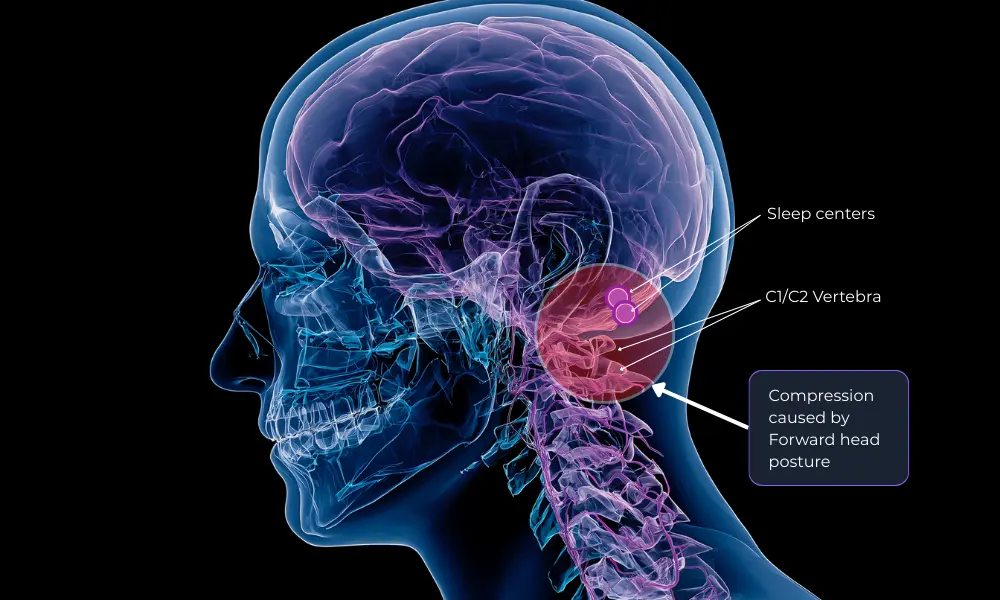
Forward head posture creates compression at the craniovertebral junction (C1-C2), affecting brainstem function where sleep-wake centers are located. This mechanical interference disrupts the reticular activating system's ability to regulate sleep cycles
Even when you're lying down:
You might think, "But I'm horizontal when sleeping—doesn't that eliminate postural stress?"
No. Here's why:
When you have forward head posture during the day, your neck muscles adapt. They shorten anteriorly (front) and lengthen posteriorly (back). When you lie on your back with a pillow, you're often maintaining—or even worsening—this forward head position for 8 hours.
The Breathing Connection:
Forward head posture also restricts your diaphragm excursion (breathing depth). Reduced oxygen intake = increased sympathetic tone = lighter sleep. The mechanical restriction at your neck directly impairs the breathing mechanics required for deep sleep.
Why This Matters:
You can optimize your sleep environment perfectly—darkness, temperature, noise control, wind-down routine—but if your structural positioning maintains sympathetic activation, you'll stay in light sleep stages. Your body physically cannot enter deep restorative sleep when it's receiving constant threat signals from mechanical dysfunction.
This is why the structural component must be addressed. Environmental factors are necessary but insufficient.
Two Techniques That Prove the Posture-Sleep Connection
These techniques demonstrate how structural positioning affects sleep quality. They provide partial relief (15-25% improvement), proving the concept works. Complete restoration requires comprehensive protocols.
Suboccipital Release
What It Targets: The tiny muscles at the base of your skull that maintain tension when you have forward head posture
Why It Works: Releases the constant arousal signal these muscles send to your reticular activating system
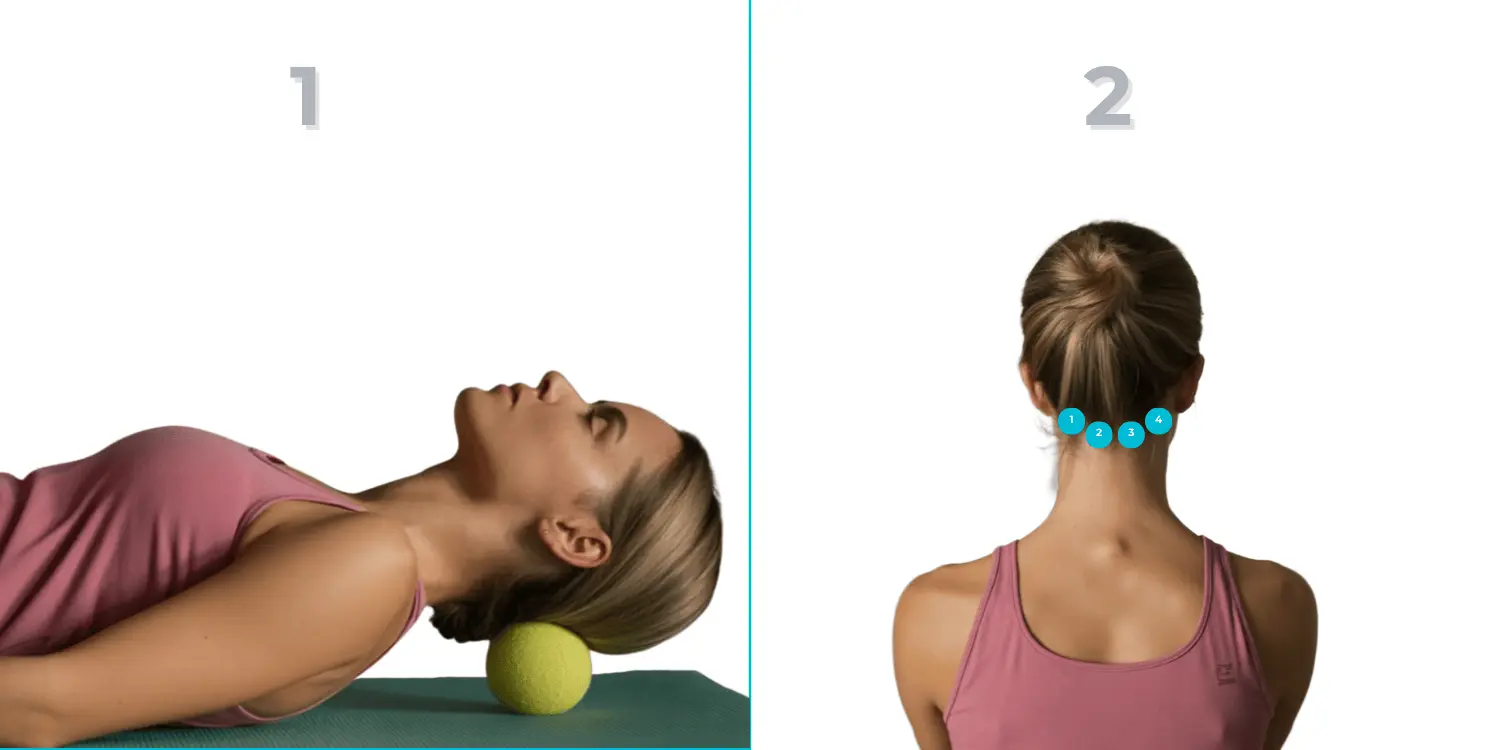
Tennis ball placement at skull base for suboccipital muscle release — Click to enlarge
How to Perform:
Lie on your back. Place a tennis ball at the base of your skull where it meets your neck. Allow your head weight to compress the ball into the tender spots. Hold for three to five minutes before bed breathing deeply and slowly. Move ball slightly to find most tender areas. Perform nightly to reduce sympathetic activation.
What to Expect:
- Immediate reduction in base-of-skull tension
- Easier time falling asleep
- Reduced night wakings during first 3 hours of sleep
- Noticeable improvement in 1-2 nights
- 15-20% sleep quality improvement with consistent use
Why This Alone Isn't Enough:
This technique releases immediate tension but doesn't correct the underlying forward head posture that created the problem. The tension returns daily from sustained postural strain. It proves the connection exists but doesn't address root cause.
Scalene Release
What It Targets: The side neck muscles (scalenes) that become chronically tight from forward head posture and compensatory breathing patterns
Why It Works: Releases tension in muscles that maintain head position and restrict breathing depth—both factors that prevent deep sleep
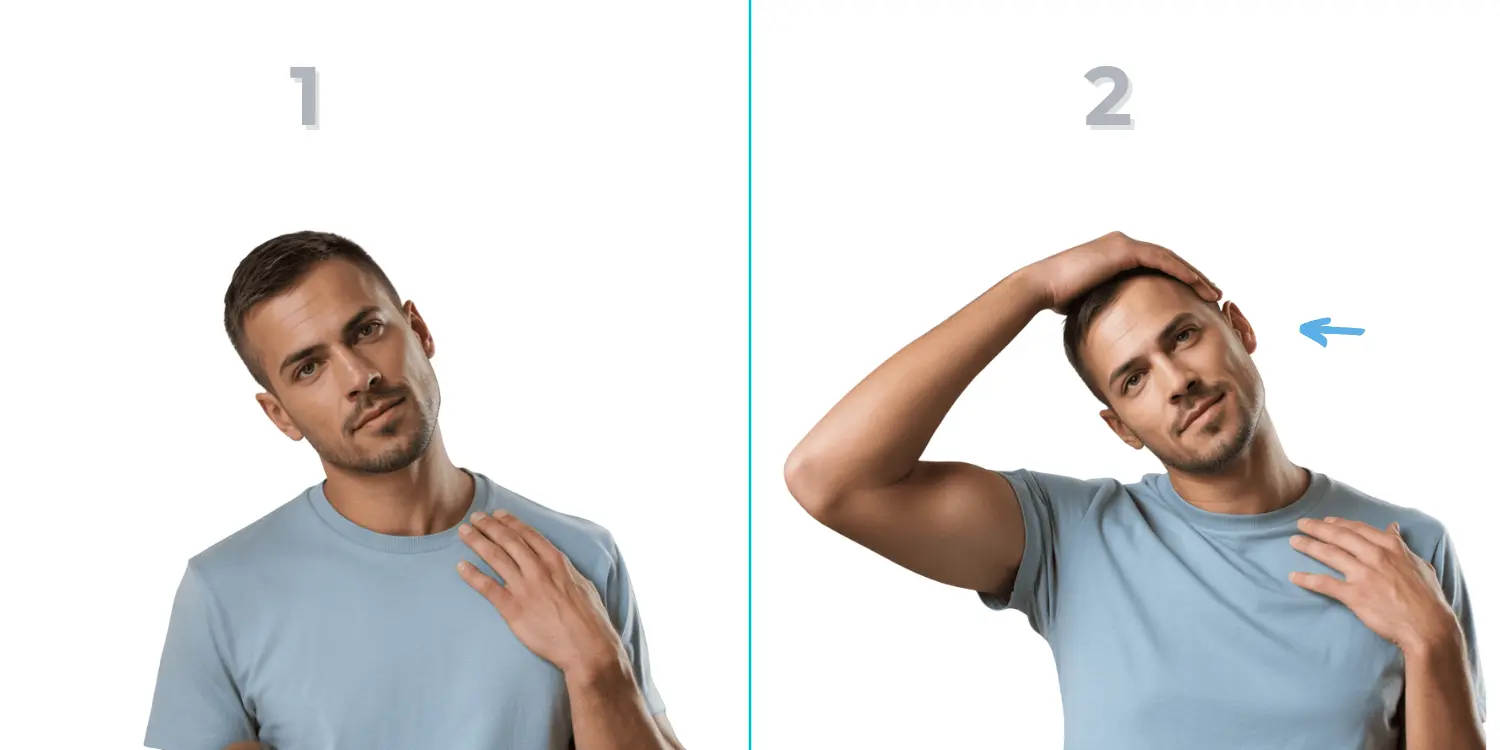
Scalene release: Apply gentle pressure to side neck, hold 2-3 minutes per side — Click to enlarge
How to Perform:
Sit or lie comfortably. Tilt head away from side being released. Place fingers on side of neck between collarbone and jaw. Apply gentle sustained pressure for two to three minutes breathing deeply. Find tender spots and hold pressure until tension releases. Perform both sides nightly before bed. Repeat as needed for persistent tightness.
What to Expect:
- Easier breathing depth
- Reduced side neck tension
- Less shoulder tension
- Improved sleep onset
- 10-15% improvement with consistent use
Why This Alone Isn't Enough:
Scalene release addresses immediate tension but doesn't correct the forward head posture and shallow breathing patterns creating the problem. The tension returns daily from sustained postural dysfunction and stress-driven breathing.
Combined Effect:
Using both techniques together (suboccipital release + scalene release) before bed provides approximately 15-25% improvement in sleep quality. You'll notice:
- ✓ Faster sleep onset
- ✓ Fewer night wakings
- ✓ Deeper breathing during sleep
- ✓ Reduced morning neck and shoulder tension
WHY THESE TWO TECHNIQUES ALONE WON'T RESTORE DEEP SLEEP
What's Missing for Complete Restoration:
These techniques are reactive (temporary relief) not corrective (permanent fix). Complete restoration requires addressing all three pillars together:
PILLAR 1: Physical Position & Structural Alignment
Daytime posture correction (the root dysfunction you create during 16 waking hours), progressive strengthening, sleep position optimization—addressing positioning throughout your entire day, not just the 8 hours you sleep.
PILLAR 2: Nervous System State & Autonomic Regulation
Behavioral protocols that retrain your autonomic nervous system for sustained parasympathetic dominance during sleep.
PILLAR 3: Lifestyle Patterns & Environmental Optimization
Temperature protocols, light timing, circadian alignment—the environmental factors integrated with structural correction.
All three pillars must function together in the correct sequence for 70-80% restoration. Isolated techniques achieve 15-25% at best.
Ready to Address All Three Pillars Systematically?
The two techniques above prove the posture-sleep connection is real and significant. They provide partial relief—showing you that structural positioning affects your sleep quality.
But complete restoration requires addressing physical position, nervous system state, and lifestyle patterns together in the correct sequence.
The BaseHealthBlueprint Deep Sleep Blueprint is the only program that systematically addresses all three pillars—with particular emphasis on the structural component that every other sleep program ignores.
See the Complete Deep Sleep Protocol →When to See a Healthcare Professional
These techniques are appropriate for postural-related sleep disruption. However, certain conditions require professional evaluation:
Seek Medical Evaluation If:
- Severe sleep apnea or suspected breathing disorder
- Sleep paralysis or narcolepsy symptoms
- Chronic insomnia lasting 6+ months unresponsive to interventions
- Severe neck pain or neurological symptoms
- Recent trauma or injury
- Unexplained daytime sleepiness despite adequate sleep duration
Appropriate For Self-Application:
- Difficulty falling asleep (sleep onset latency)
- Frequent night wakings without breathing issues
- Light, unrefrestorative sleep
- Neck tension related to poor posture
- Forward head posture confirmed by mirror/photos
- No neurological symptoms
These techniques complement professional care—they don't replace evaluation when needed.