You woke up with neck pain. Again. The discomfort that started as occasional now shows up most mornings. You're searching for relief methods that actually work—not generic advice that doesn't address your specific situation.
Quick Relief vs. Root Cause: Understanding the Difference
Here's what you need to know first: The 10 relief methods below provide temporary symptom management. They work, they're evidence-based, and you should use them. But they don't fix the underlying cause.
Think of it like this: If you have a nail in your tire, adding air provides temporary relief. But until you remove the nail and patch the hole, you'll keep needing to add air.
Neck pain typically comes from one of three specific postural conditions—text neck, forward head posture, or dowager's hump. Each requires targeted correction, not just symptom relief.
This guide provides both: Immediate relief methods to manage your pain today, and assessment tools to identify which condition you have so you can fix it permanently.
When to See a Doctor Immediately
⚠️ Seek medical care immediately if you experience any of these:
- Severe pain after injury or trauma
- Numbness, tingling, or weakness in arms/hands
- Difficulty walking or loss of coordination
- Fever with neck pain and stiffness
- Severe headache with neck stiffness
- Difficulty swallowing or breathing
If none of these apply, continue with the relief methods below.
10 Evidence-Based Relief Methods
These techniques provide the fastest relief—use them when you need help right now.
1. Gentle Neck Stretches (Relief in 2-3 Minutes)
Why it works: Increases blood flow and temporarily relieves muscle tension without forcing range of motion.
How to do it:
- Sit or stand with relaxed shoulders
- Slowly tilt head to right (ear toward shoulder), hold 10 seconds
- Return to center, repeat left side
- Tilt chin down toward chest, hold 10 seconds
- Gently tilt head back (eyes to ceiling), hold 5 seconds
- Do 2-3 complete cycles
What you'll feel: Mild stretch, possible clicking/popping (normal if painless), temporary relief.
2. Doorway Chest Opener (Relief in 2-3 Minutes)
Why it works: Tight chest muscles pull shoulders forward, creating compensatory neck strain. Opening the chest relieves this pattern.
How to do it:
- Stand in doorway
- Place forearms on door frame (elbows at 90 degrees)
- Step forward until strong stretch across chest
- Keep ribs down (don't arch back excessively)
- Hold 30-45 seconds
- Breathe deeply throughout
What you'll feel: Strong stretch across front of chest and shoulders. Shoulders naturally pull back.
Slightly more involved techniques that provide deeper, longer-lasting relief.
3. Upper Trapezius Self-Massage (Relief in 5-8 Minutes)
Why it works: Releases trigger points in the thick muscle between neck and shoulder that becomes extremely tight with forward head posture.
How to do it:
- Reach across body with opposite hand
- Grasp thick muscle between neck and shoulder
- Apply firm pinching pressure for 30 seconds
- Move along muscle from shoulder toward neck
- Find 3-4 tender spots, hold each 30 seconds
- Repeat other side
What you'll feel: Initially tender/painful, then releasing sensation. Immediate increase in neck mobility.
4. Tennis Ball Neck Release (Relief in 5-10 Minutes)
Why it works: Small muscles at base of skull become extremely tight and cause referred pain into head and neck.
How to do it:
- Place 2 tennis balls in sock (prevents rolling)
- Lie on back, position balls at base of skull (one each side of spine)
- Relax head weight onto balls
- Gently nod head yes/no (10 times each)
- Hold for 3-5 minutes total
What you'll feel: Intense pressure initially, possible tingling (normal), then gradual release and pain decrease.
5. Ice Application (Relief in 10-15 Minutes)
Why it works: Ice reduces inflammation and numbs acute pain. Most effective in first 48-72 hours after onset.
How to apply:
- Wrap ice pack in thin towel (prevents ice burn)
- Apply to most painful area
- Keep on for 15 minutes
- Remove for 45 minutes before reapplying
- Repeat 3-4 times daily as needed
What you'll feel: Initial cold shock, then numbness. Pain decreases after one application.
✅ Best for: Acute flare-ups, recent onset, morning stiffness.
6. Heat Therapy (Relief in 15-20 Minutes)
Why it works: Heat increases blood flow, relaxes chronically tight muscles, and reduces muscle spasm.
How to apply:
- Use heating pad, microwavable heat wrap, or hot shower
- Apply to upper back and neck (not directly on spine)
- Keep on for 15-20 minutes
- Can repeat every 2 hours as needed
What you'll feel: Deep relaxation, decreased muscle tension, improved range of motion.
✅ Best for: Chronic tension that's been present for days/weeks, before movement or exercise.
When you need stronger relief and can wait for it to take effect.
7. Over-the-Counter Relief (Relief in 30-45 Minutes)
Why it works: NSAIDs (ibuprofen, naproxen) reduce inflammation and pain. Acetaminophen addresses pain only.
Usage guidelines:
- Ibuprofen (Advil, Motrin): 400-600mg every 6-8 hours with food
- Naproxen (Aleve): 220-440mg every 8-12 hours with food
- Acetaminophen (Tylenol): 500-1000mg every 6 hours
- Don't exceed maximum daily dose
- Consult doctor if taking other medications
What you'll feel: Pain reduction within 30-45 minutes, lasting 4-6 hours.
⚠️ Warning: Masks symptoms without addressing cause. Useful for acute relief, concerning if needed daily.
Daily habits and environmental changes that prevent neck pain from returning.
8. Desk Posture Reset (Prevention - Immediate Effect)
Why it works: Most neck pain develops during work hours from forward head position maintained while computing.
How to reset:
- Screen top at eye level (use monitor riser if needed)
- Screen 20-26 inches from face
- Shoulders over hips when sitting
- Ears over shoulders (not forward)
- Every hour: stand, walk briefly, reset position
What you'll feel: Immediate decrease in neck strain when properly positioned.
💡 Pro tip: Set hourly alarm to reset position. Most people drift forward within 20-30 minutes.
9. The 20-20-20 Rule (Prevention Throughout Day)
Why it works: Prolonged static position (even "good" posture) creates tissue stress and pain.
The protocol:
- Every 20 minutes
- Look at something 20 feet away
- For 20 seconds
- Add gentle head movements (look up, side to side)
What you'll feel: Prevents pain accumulation. Most effective when done consistently before pain starts.
10. Proper Sleep Positioning (Overnight Recovery)
Why it works: You spend 7-8 hours in bed. Poor positioning prevents recovery and creates morning stiffness.
Optimal positions:
- Back sleeping: Pillow height keeps neck neutral (not flexed or extended)
- Side sleeping: Pillow fills gap between shoulder and head
- Avoid: Stomach sleeping (forces rotation and extension)
- Test: If pillow too high/low, wake with neck pain
What you'll feel: Reduced morning stiffness within 2-3 nights of proper positioning.
⏱️ Quick Reference: Relief Timeline
Immediate Relief
2-5 minutes
Neck Stretches, Chest Opener
Short-Term Relief
5-20 minutes
Self-Massage, Tennis Ball, Ice, Heat
Medium-Term Relief
30-45 minutes
OTC Medications (Ibuprofen, Naproxen)
Long-Term Fixes
Prevention & Environment
Desk Setup, 20-20-20 Rule, Sleep Position
When Quick Relief Becomes Daily Habit: The Warning Sign
If you're using these relief methods daily, you've crossed into chronic pain territory. This isn't a failure—it's valuable diagnostic information telling you there's an underlying structural issue that needs correction.
The pattern looks like this:
- Morning: Wake with stiffness, use stretches/heat to function
- Mid-day: Pain returns after 2-4 hours at computer
- Evening: Need massage, ice, or medication to sleep comfortably
- Repeat daily
This cycle indicates you have one of three specific postural conditions causing your pain. The assessment below identifies which one.
📊 Critical Understanding:
These 10 relief methods manage symptoms. They're essential for daily function. But they don't fix the biomechanical dysfunction creating your pain. That requires identifying your specific condition and following a targeted correction protocol.
Which Postural Condition Is Causing Your Pain?
Check the boxes that apply to you. If you have 4+ boxes checked in any category, you likely have that condition.
TEXT NECK
If 4+ boxes checked: You likely have text neck
FORWARD HEAD POSTURE
If 4+ boxes checked: You likely have forward head posture
DOWAGER'S HUMP
If 4+ boxes checked: You likely have dowager's hump
Multiple conditions? If you checked 4+ boxes in TWO categories, you likely have overlapping conditions. Start with the one causing the most pain.
None match clearly? If symptoms don't fit any box, or if you have numbness/tingling past your elbow, see a healthcare provider for professional evaluation.
If You Have Text Neck: What You Need to Know
Text neck develops from the specific angles and duration of smartphone, tablet, and laptop use. The average person spends 5-7 hours daily looking down at devices, creating forward head posture specifically during these activities—not as a constant structural issue.
What Makes Text Neck Different:
Unlike forward head posture (which is constant 24/7), text neck is activity-triggered. Your posture may be relatively normal when standing or walking, but collapses forward the moment you pick up your phone or sit at a computer.
The Device-Specific Problem:
Looking down at a phone held at chest height creates 60 degrees of neck flexion. At this angle, your neck supports the equivalent of 60 pounds instead of your head's actual 10-12 pounds. Do this for 3-5 hours daily, and you've created chronic overload.
Why General Posture Advice Fails:
Text neck requires device-specific corrections—smartphone positioning protocols, workstation ergonomics, screen height adjustments, and exercises targeting the muscle imbalances created by prolonged downward gaze.
What Complete Correction Requires:
Detailed ergonomics for every device type, specific exercises targeting forward-gaze muscle imbalances, progressive strengthening for deep neck flexors, and environmental modifications that prevent relapse.
Read Complete Text Neck Correction Guide →If You Have Forward Head Posture: What You Need to Know
Forward head posture (FHP) is a constant structural misalignment—your head sits forward of your shoulders 24/7, not just during specific activities. This is the most common postural dysfunction in adults, affecting an estimated 66% of the population.
What Makes FHP Different:
Unlike text neck (activity-triggered) or dowager's hump (visible tissue buildup), FHP is a persistent biomechanical pattern your nervous system has accepted as "normal." Your proprioception—your body's sense of position in space—has adapted to dysfunction.
The Measurement Standard:
Proper head alignment: ear canal directly above shoulder when viewed from the side. FHP: head 2-4 inches forward, creating chronic load on posterior neck muscles and reduced breathing capacity (20-30%).
Why It's So Common:
Years of computer work, driving with seat too far back, smartphone use, and poor sleep position create gradual forward migration. Most people develop measurable FHP by age 30.
The Proprioceptive Challenge:
Correcting FHP requires more than exercises—you must retrain your nervous system's perception of "neutral." This involves specific assessment protocols (wall test, forward head measurement), consistent postural resets, and exercises that create new neural pathways.
What Complete Correction Requires:
Detailed assessment protocol to measure your exact severity, specific exercises for FHP correction, proprioceptive retraining techniques, and progressive strengthening to make proper alignment your new default position.
Read Complete Forward Head Posture Guide →If You Have Dowager's Hump: What You Need to Know
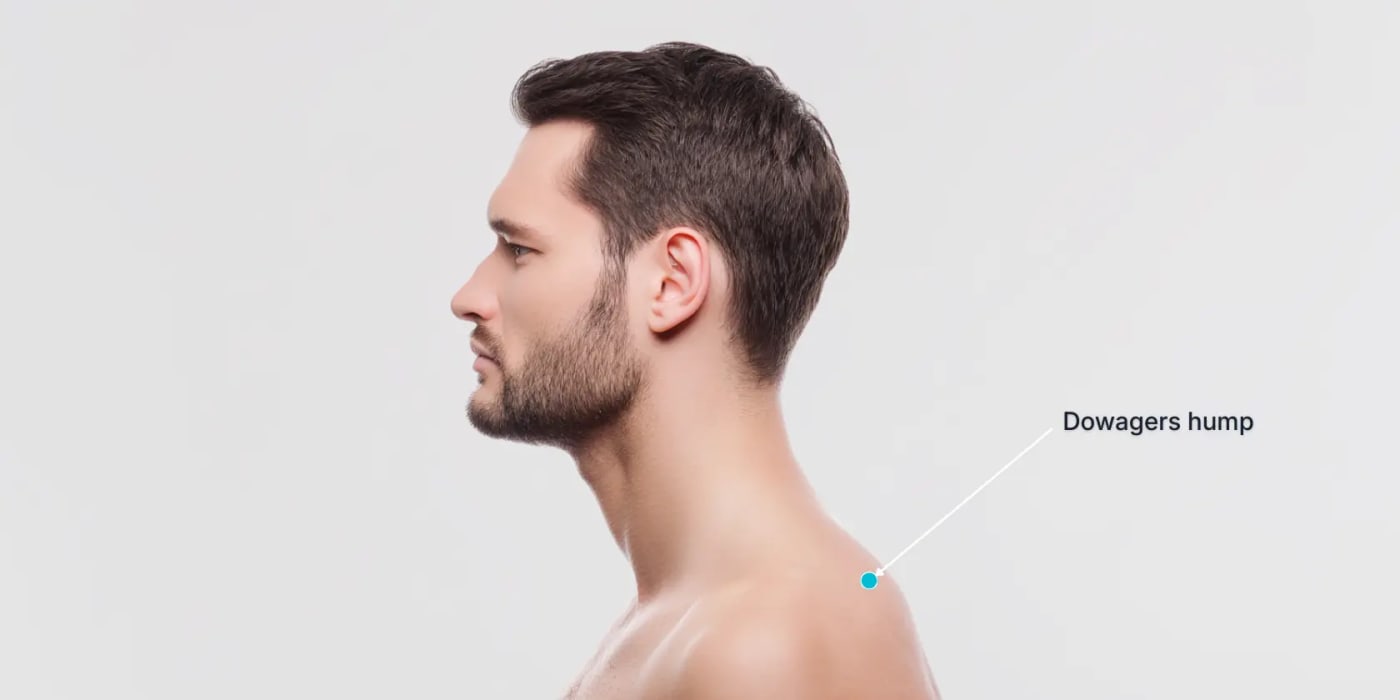
Dowager's hump (cervicothoracic kyphosis) is the visible rounded protrusion at the base of your neck where it meets your upper back. Unlike text neck or FHP (primarily muscular/postural), dowager's hump involves actual tissue buildup and structural changes.
What Makes Dowager's Hump Different:
This condition indicates advanced kyphosis with fat pad accumulation, fascial thickening, and potential vertebral wedging. It's not just "bad posture"—it's structural adaptation to years of forward head position.
The Visibility Factor:
Dowager's hump is externally obvious—visible in mirrors, photos, and through clothing. This often causes significant self-consciousness. Many people first notice it in their 40s-60s, though younger people with severe forward head posture can develop it earlier.
Unique Correction Requirements:
Correcting dowager's hump requires specific upper back mobilization and thoracic extension work that general neck exercises don't address. You must restore thoracic spine extension, break down fascial restrictions, and address sleep and driving positions that perpetuate the condition.
What Complete Correction Requires:
Complete protocol including thoracic mobility work, sleep position optimization (critical for this condition), driving posture corrections, specific exercises for tissue remodeling, and realistic timelines for visible reduction.
Read Complete Dowager's Hump Guide →Ready to Fix Your Neck Pain Permanently?
The 10 relief methods above provide temporary symptom management—essential for getting through your day. The assessment identifies which condition is causing your pain.
The BaseHealthBlueprint Posture Reset Blueprint provides the complete correction protocol for text neck, forward head posture, and dowager's hump.
See the Complete Solution Now →When Professional Evaluation is Needed
See a healthcare provider immediately if you experience:
Neurological Symptoms:
- Numbness or tingling radiating past elbows into hands
- Weakness in hands or arms (difficulty gripping, lifting)
- Loss of coordination or balance
- Severe dizziness with neck movement
Red Flag Symptoms:
- Recent trauma or injury to neck/head
- Severe pain that worsens progressively
- Fever with neck pain and stiffness
- Difficulty swallowing or breathing
Chronic Conditions Requiring Monitoring:
- Pain persisting despite 4-6 weeks of relief methods
- History of cervical spine surgery
- Diagnosed arthritis, osteoporosis, or disc disease
Working with Professionals:
Physical therapists, chiropractors, and orthopedic specialists can provide hands-on treatment, imaging interpretation, and customized protocols for complex cases. They should complement—not replace—your self-directed correction work.
Most chronic neck pain (85-90%) is postural and corrects with proper protocol, but rule out serious conditions first.